Pittsburgh Rare on British Soil: The Steak Order That Makes Kitchen Doors Slam
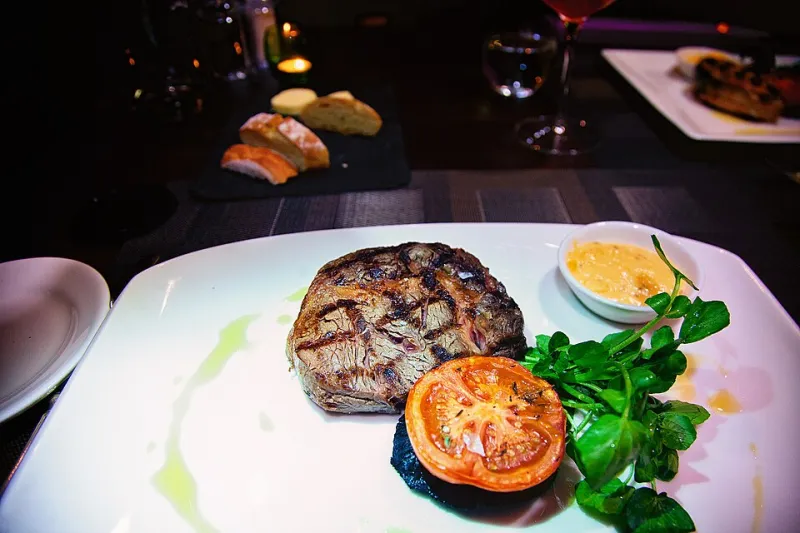
Photo: Jack Oughton, CC BY-SA 3.0, via Wikimedia Commons
There's a moment every steak lover knows. You've scanned the menu, you know what you want, and when the waiter asks how you'd like it cooked, you say the words: 'Blue. And I mean properly blue.' Somewhere beyond the kitchen door, you imagine a chef wincing.
In New York — and especially in Pittsburgh, where the style was born — this is barely a conversation. 'Black and blue' means a steak seared ferociously on the outside at extreme heat, then left almost entirely raw within. The crust is charred and smoky; the centre is cool, soft and crimson. It's a study in contrast, and done properly, it's magnificent.
In Britain, it's a negotiation.
Why the Flinch?
The tension comes down to regulation and risk appetite. UK guidance on catering is stricter than the American equivalent: whole cuts of beef are generally expected to be seared on all surfaces, but many kitchens — particularly chain restaurants and hotel groups — have house policies that effectively rule out anything below 'rare'. Liability, insurance terms and a general culture of caution mean the path of least resistance is to nudge your blue steak up to rare and hope you don't notice.
And often, you don't. The difference between a rare and blue steak on a busy Friday service is invisible once it's on the plate under dim lighting. But for those of us who order it deliberately, the betrayal is unmistakable: a warm grey band around the edge, a centre that's lost its chill.
The Chefs Who Say Yes
The good news is that plenty of British kitchens treat a blue order as a compliment rather than a hazard. Talk to chefs at the American-style steakhouses that have multiplied across London, Manchester and Glasgow over the past decade, and a pattern emerges: the ones confident in their sourcing are the ones happy to cook low and fast — or rather, hot and barely.
'If I know the farmer, the abattoir and the ageing process, I'll cook your steak however you like it,' one head chef at a Manhattan-style grill in Shoreditch told us. 'If I'm getting vacuum-packed fillets off a broadline wholesaler, no chance. The blue order is a test of the whole supply chain.'
That's the crux of it. A truly blue steak removes every place for a kitchen to hide. There's no sauce, no resting, no carry-over cooking to mask a problem. The meat has to be excellent, handled properly and cooked with genuine skill — a screaming-hot plancha or grill, sixty to ninety seconds a side, and out.
Which Cuts Work Black and Blue
Not every steak suits the treatment. You want cuts that are tender enough to enjoy rare and thick enough to develop a proper char without the interior warming up:
- Fillet — the classic blue choice. Buttery, mild, and forgiving.
- Sirloin — brilliant with a hard sear; the fat needs the heat, the centre doesn't.
- Ribeye — divisive. Some love the contrast of rendered fat and cool centre; others find the raw fat unappealing. Order rare instead if unsure.
- Porterhouse or T-bone — a blue-cooked fillet side with a rare strip side. Arguably the best of both worlds.
Avoid anything thin, braising cuts, and flat irons — they'll overcook before the crust develops. And skip the marinade; it burns bitter at Pittsburgh temperatures.
What to Say When the Waiter Hesitates
You don't need a speech, but a little diplomacy helps. Try: 'Blue, please — cool centre, just charred. I understand if the kitchen can't do that, but I'd rather know now than after.' It's polite, it's clear, and it gives them a graceful exit. A good server will check with the kitchen. A great one will come back and say yes.
If the answer is no, take it as information about the kitchen, not a personal slight — and order the rare instead, or better yet, book somewhere else next time.
The Verdict
Britain's food culture has matured enormously — we eat raw beef tartare without blinking and argue about dry-ageing like we invented it. The blue steak shouldn't be the final frontier. When it's done right, black and blue is the most thrilling thing a grill can produce: fire on the outside, silk within.
So keep asking. Politely, firmly, and with your wallet as your witness. The kitchens that say yes are the ones worth your custom.