Twelve Quid, Thinly Sliced: Are Britain's Delis Really Giving You the Full New York Stack?
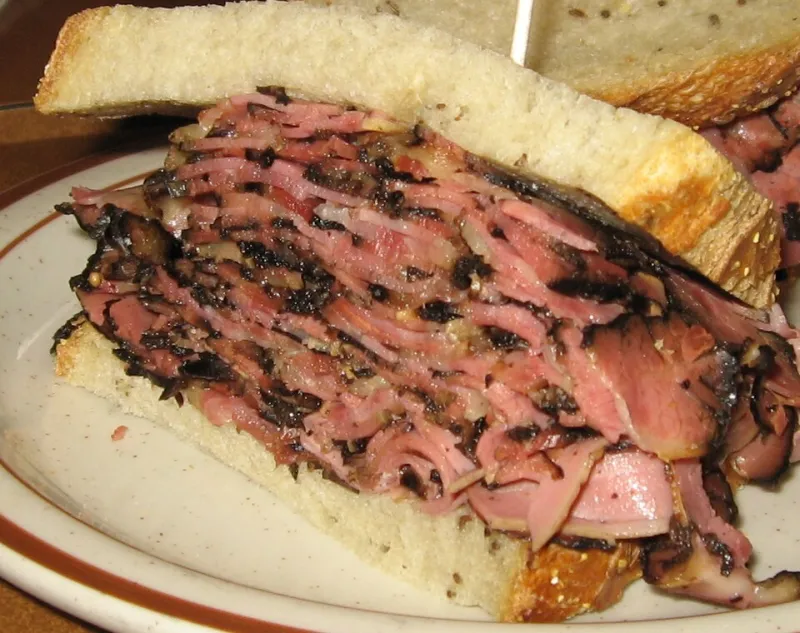
Photo: Arnold Gatilao, CC BY 2.0, via Wikimedia Commons
There's a moment that happens at every proper New York deli counter. The carver pulls a brick of pastrami from the steam tray, lays it on the board, and starts slicing. You watch the pile grow. And grow. By the time they've finished, you're looking at six ounces of meat, minimum, pressed between two slices of rye that exist purely as a formality.
Now try that experience at a British deli charging £14.50 a sandwich. Sometimes you get the tower. Sometimes you get three artful shingles of meat and a lot of gherkin garnish. We spent six weeks eating our way around the UK's pastrami scene to work out which is which.
What You're Actually Paying For
Let's start with the numbers, because they don't flatter anyone. At Katz's on the Lower East Side, a pastrami on rye will set you back around $26 — call it £20 with tax and tip. For that you get roughly 250g of hand-carved meat, cured for a minimum of 30 days, smoked, then steamed for hours before it hits the board.
The British equivalent averages £11 to £16. That wouldn't be bad value if the portions matched, but our spot checks found servings ranging from a generous 180g down to a frankly cheeky 90g. At the top end, that's near-parity pricing for less meat. At the bottom, you're paying Katz's rates by weight — roughly £150 a kilo for something you could make at home for a tenner.
There's a name for this, and the traders won't thank us for it: the nostalgia premium. Slap a fire escape mural on the wall, put a pickled half-sour in a jar, and suddenly the pricing logic of the Lower East Side applies to a railway arch in Salford.
The Curing Question
Portion is only half the story. The real divide between the delis that earn their reputation and the ones trading on it is time.
Authentic pastrami — whether beef navel or brisket — needs a wet cure of at least a week, ideally closer to a month, followed by a long smoke and a slow steam. It's a five-stage process and there are no shortcuts that don't show up in the eating.
We asked a handful of UK delis about their process. The good ones talked for twenty minutes without pausing: cure times, wood choice, the argument over navel versus brisket. One Leeds counter cures for 28 days and steams to order, and you can taste every one of those days in the finished sandwich — a peppery crust, a proper smoke ring, meat that yields in long, soft strands rather than crumbling.
The bad ones, when asked, got vague. "House-cured" turned out to mean bought in, sliced thin, and griddled to fake the freshness. If the meat on your sandwich has the uniform, pressed look of supermarket deli slices, you already know the answer.
The Rye Problem
Here's an underrated culprit: the bread. New York rye — the real thing, with a sour tang and a crackling crust — is still genuinely hard to find in Britain. Plenty of delis make do with a soft, sweet loaf that's rye in name only, and it changes the whole equation. A proper pastrami sandwich is a structural negotiation between fatty meat and sturdy bread. Put it on bready cotton wool and the whole thing collapses into a wet mess by the third bite.
The best British delis have solved this by baking their own, and it shows. The ones we'd return to all had either an in-house rye or a relationship with a proper bakery. Treat the bread as a red flag indicator: if they've sweated this detail, they've probably sweated the rest.
Our Verdict: Who Earns the Name
We're not going to name-and-shame individual counters — this scene is small and people talk — but here's the framework we'd hand any UK diner:
You're getting the real thing if: the meat is carved to order in front of you, the stack is at least 150g, the rye has structure, and the counter staff can tell you the cure time without checking a card.
You're paying the nostalgia tax if: the meat arrives pre-sliced, the portion hides under half a pound of coleslaw, and the menu leans harder on the Brooklyn Bridge photo than on the butchery.
The encouraging news is that the genuine article does exist outside New York now. London's best counters can go toe-to-toe with the originals on flavour, even if the wallet damage stings. And in Manchester, Leeds and Glasgow, a second wave of delis is emerging with slightly smaller ambitions and noticeably fairer prices — £9 for an honest, generous sandwich beats £16 for theatre every time.
The pastrami on rye was never meant to be a luxury item. It was worker's food, invented by immigrants who understood that time and salt are the only real ingredients. The British delis that remember this are worth every penny. The rest are just selling you a postcard.